
Susan Collins Blames 'Trump Tsunami' for Losing Maine Senate Seat
Sen. Susan Collins lost her Maine Senate seat to Democrat Troy Jackson after 30 years. Here's what she said about the 'Trump tsunami' and her defeat.

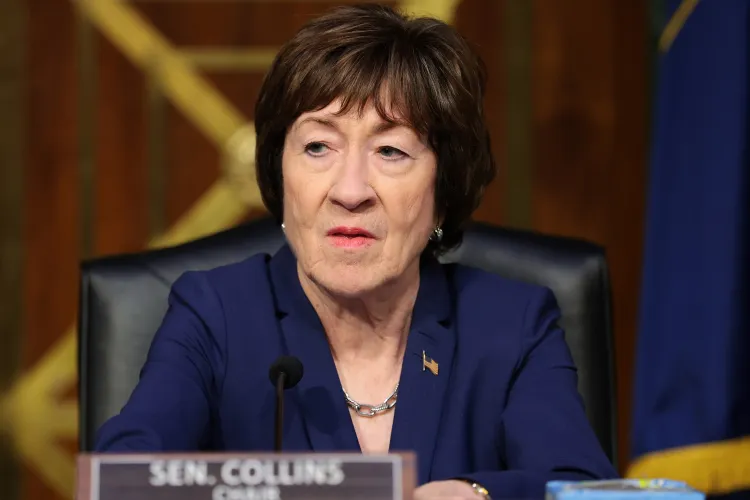
Sen. Susan Collins is opening up about the election loss that ended her 30-year run in the U.S. Senate.
The Maine Republican, 73, lost her bid for a sixth term to Democrat Troy Jackson, 58, in the midterm election on Tuesday, Nov. 3. Jackson won 53.3% of the vote to Collins' 46.7%, according to results reported by People.
A day later, Collins said she believed national politics played a big role in her defeat.
"I was caught up in the Trump tsunami that swept away many incumbent Republican senators," she told The New York Times on Wednesday, Nov. 4.
"The honor of my life"
Collins did not give a concession speech in Bangor on election night. Instead, her campaign released a statement after she called Jackson to concede, according to WGME.
"It has been the honor of my life to serve the people of Maine in the United States Senate," Collins said. "I'm proud of all I have been able to accomplish for our state and for our country in the past 30 years."
She also said she had reached out to her opponent. "I called Troy Jackson tonight to congratulate him and to assure him that my staff and I will work to ensure a smooth transition," Collins said.
"It is never enough"
In her interview with The New York Times, as reported by The Boston Globe, Collins pushed back on the idea that she had stuck too closely to President Donald Trump.
She pointed to her vote in 2021 to convict Trump in his second impeachment trial, which broke with most of her party. "Everybody ignores the fact that I voted to convict him in the second impeachment trial," she said.
Collins said that, in her view, her breaks with the president were never enough for some voters. "What bigger break could there be? It is never enough. I want results and they want angry rhetoric," she said.
She also pointed to the federal funding she secured for Maine as chair of the Senate Appropriations Committee.
Collins also compared her loss to that of another famous Maine Republican, Margaret Chase Smith, who lost her own Senate seat in 1972 after 24 years in the Senate. "I have now had my Margaret Chase Smith moment," Collins said.
Jackson: "The real work begins"
Jackson declared victory early Wednesday morning and thanked the voters who backed him.
"You've lifted one of your own all the way to the United States Senate," he told supporters, according to WGME. "And now, now, obviously the real work begins and now we have to make it count."
He also made a promise to Mainers. "I'm in this position to fight for people that don't have a voice or don't know," Jackson said. "You won't have to wonder whether I'm going to show up for you."
Watch Jackson's victory and Collins' concession
CBS 13 News' video of Troy Jackson declaring victory in the Maine Senate race as Susan Collins concedes.
Who is Troy Jackson?
Jackson's path to the Senate was anything but typical.
He grew up in Allagash, a town of about 230 people at the northern tip of Aroostook County, according to WTOP. His family has worked as loggers for five generations, and he started logging himself at age 19.
"What I am is a guy from northern Maine that's a logger," Jackson said in his speech after winning the Democratic nomination.
His political career had its share of ups and downs. He first ran for state office as a Republican and lost, then won as an independent before joining the Democratic Party in 2004. He served in the Maine Senate from 2008 to 2014 and again from 2016 to 2024, including as Senate president from 2018 to 2024. He fell short in a 2014 bid for the Democratic nomination in Maine's 2nd Congressional District, and in 2023 he lost a local first selectman race in Allagash by just six votes, according to WTOP.
Jackson ran for governor earlier this year but finished third in the Democratic primary on Tuesday, June 9. He later became the party's Senate nominee after Graham Platner, the original Democratic nominee, withdrew from the race in July following an allegation that he denies.
Maine Democrats officially chose Jackson at their convention in Bangor on Saturday, July 25, where he won 566 of 571 delegate votes, according to NPR. That left him about 100 days to campaign against Collins.
A heated campaign
The race was one of the most closely watched Senate contests in the country.
Collins was widely seen as one of the most vulnerable Republican senators up for reelection this year. She was the last Republican in New England's congressional delegation, and Maine has backed the Democratic presidential candidate statewide in every election since 1992.
Collins' campaign criticized Jackson's "partisan record" and promised a "vigorous and issues-oriented campaign" after he became the nominee, according to NPR. She also reported about $11 million in cash on hand in her latest filing at the time.
Jackson ran on an economic populist message, backing Medicare for All and higher taxes on the very wealthy and large corporations.
Things got tense during an October debate, when Jackson told Collins to "shut up" after she suggested that a protester who interrupted the event was one of his supporters. He later said he did not regret the remark, according to The Associated Press.
A long career comes to an end
Collins was first elected to the Senate in 1996. Had she won a sixth term, she would have become the longest-serving senator in Maine history, according to WGME.
Over the years, she built a reputation as a moderate who sometimes broke with her party. In 2016, she wrote in The Washington Post that she would not vote for Trump, citing his disregard for treating others with respect. In 2021, she was one of seven Republican senators who voted to convict him in his second impeachment trial.
Her loss was part of a bigger night for Democrats. The party won control of both the House and the Senate, according to CBS News, and also flipped several other Senate seats, including in Iowa, Kansas and South Carolina.
What's next
Jackson is expected to be sworn in as Maine's new senator in January.
For Collins, the coming weeks will be about wrapping up three decades of work. She has said she and her staff will work to ensure a smooth transition for the incoming senator.
As she put it in her statement, serving Maine in the Senate was "the honor of my life."


